Riset
Publikasi dan hasil riset terkini.
Development of Integrated Physics Teaching Materials for Landslide Disaster Mitigation and Islamic Science on Newton's Law for Gravity
This research is motivated by the high potential for natural disasters, one of which is landslides that occur in areas with mountainous topography. This condition requires the strengthening of disaster mitigation education from an early age through formal education channels, especially in schools in disaster-prone areas. However, physics learning in Islamic schools generally still focuses on theoretical concepts, has not been integrated with the context of disasters and Islamic values, and is supported by less contextual teaching materials. This research aims to develop integrated physics teaching materials for landslide disaster mitigation and Islamic science on Newton's Law of Gravity material, as well as to examine the level of validity and response of students to the developed teaching materials. The research method used is research and development with the Borg and Gall procedure. The teaching material products were validated by material experts and media experts, and tested for readability and user response in MA Muwahidun students. The results of the study showed that the teaching materials developed had a very high level of feasibility with a validity percentage of 80.41%. The readability test showed a percentage of 90% with the easy-to-understand category, while the students' response obtained an average score of 86.44% with a very positive category. These findings show that integrated physics teaching materials for disaster mitigation and Islamic science are effective in supporting contextual learning, improving disaster preparedness, and instilling Islamic values. Thus, this teaching material is suitable for use as an alternative to learning physics in Islamic schools in disaster-prone areas.
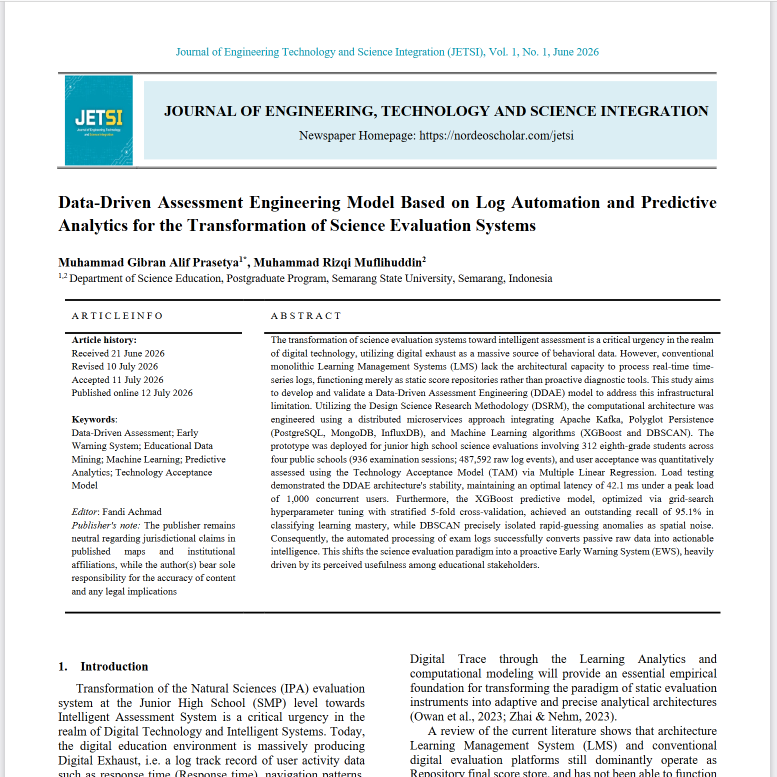
Data-Driven Assessment Engineering Model Based on Log Automation and Predictive Analytics for the Transformation of Science Evaluation Systems
The transformation of science evaluation systems toward intelligent assessment is a critical urgency in the realm of digital technology, utilizing digital exhaust as a massive source of behavioral data. However, conventional monolithic Learning Management Systems (LMS) lack the architectural capacity to process real-time time-series logs, functioning merely as static score repositories rather than proactive diagnostic tools. This study aims to develop and validate a Data-Driven Assessment Engineering (DDAE) model to address this infrastructural limitation. Utilizing the Design Science Research Methodology (DSRM), the computational architecture was engineered using a distributed microservices approach integrating Apache Kafka, Polyglot Persistence (PostgreSQL, MongoDB, InfluxDB), and Machine Learning algorithms (XGBoost and DBSCAN). The prototype was deployed for junior high school science evaluations involving 312 eighth-grade students across four public schools (936 examination sessions; 487,592 raw log events), and user acceptance was quantitatively assessed using the Technology Acceptance Model (TAM) via Multiple Linear Regression. Load testing demonstrated the DDAE architecture's stability, maintaining an optimal latency of 42.1 ms under a peak load of 1,000 concurrent users. Furthermore, the XGBoost predictive model, optimized via grid-search hyperparameter tuning with stratified 5-fold cross-validation, achieved an outstanding recall of 95.1% in classifying learning mastery, while DBSCAN precisely isolated rapid-guessing anomalies as spatial noise. Consequently, the automated processing of exam logs successfully converts passive raw data into actionable intelligence. This shifts the science evaluation paradigm into a proactive Early Warning System (EWS), heavily driven by its perceived usefulness among educational stakeholders.
Pengaruh Dukungan AI terhadap Motivasi Belajar dan Pemahaman Konsep Siswa dalam Penggunaan Modul Ajar Sains Islam Terintegrasi Ayat Qur’an
Perkembangan Artificial Intelligence (AI) dalam pendidikan mendorong terciptanya pembelajaran yang lebih adaptif dan interaktif, termasuk dalam pembelajaran Sains Islam berbasis ayat Al-Qur’an. Namun, kajian mengenai pengaruh dukungan AI terhadap motivasi belajar dan pemahaman konsep siswa masih terbatas. Penelitian ini bertujuan untuk menganalisis pengaruh dukungan AI terhadap motivasi belajar dan pemahaman konsep siswa dalam penggunaan modul ajar Sains Islam terintegrasi ayat Al-Qur’an. Penelitian menggunakan pendekatan kuantitatif dengan desain eksplanatori melalui metode Structural Equation Modeling berbasis Partial Least Squares (SEM-PLS). Sampel penelitian terdiri atas 100 siswa SMA di Kabupaten Pati yang dipilih menggunakan teknik simple random sampling. Data dikumpulkan melalui kuesioner skala Likert yang mengukur dukungan AI, motivasi belajar, dan pemahaman konsep siswa. Hasil penelitian menunjukkan bahwa dukungan AI berpengaruh positif dan signifikan terhadap motivasi belajar serta pemahaman konsep siswa. Pembahasan menunjukkan bahwa fitur AI seperti personalisasi materi, umpan balik otomatis, dan rekomendasi belajar mampu meningkatkan keterlibatan belajar siswa dan membantu pemahaman konsep biologi yang terintegrasi dengan nilai Qur’ani. Kesimpulan penelitian menegaskan bahwa integrasi AI dalam modul ajar Sains Islam menjadi strategi pembelajaran yang efektif dan relevan dalam mendukung pembelajaran sains berbasis nilai keislaman di era digital.
Dari Alat Teknis ke Mitra Belajar: Studi Literaturtentang Transformasi Peran Artificial Intelligence dalam Pembelajaran di Kelas
Integrasi Kecerdasan Buatan (AI) dalam pendidikan telah mengalami pergeseran paradigma yang signifikan seiring pesatnya inovasi teknologi mutakhir. Penelitian Systematic Literature Review(SLR) ini bertujuan untuk memetakan dan menganalisis secara kritis evolusi peran AI, dari sekadar alat otomasi administratif menjadi mitra belajar kognitif dalam ekosistem pembelajaran di kelas. Penelitian ini menerapkan metode tinjauan literatur sistematis dengan pendekatan deskriptif-kualitatif. Sumber data difokuskan pada penelusuran 12 artikel jurnal internasional bereputasi yang terindeks Scopus, diterbitkan pada rentang tahun 2020 hingga 2025. Kriteria inklusi secara ketat mencakup studi empiris maupun konseptual yang mengeksplorasi interaksi pedagogis human-AIdan adopsi AI di ruang kelas. Melalui teknik analisis tematik, hasil sintesis menunjukkan adanya lintasan transformasi peran AI yang berjenjang. Pada mulanya, AI difungsikan secara terbatas sebagai alat bantu teknis untuk otomasi tugas administratif dan sistem asesmen objektif. Seiring waktu, fungsi tersebut berkembang menjadikan AI sebagai asisten pengajaran dan tutor cerdas yang adaptif. Pada perkembangannya saat ini, kemunculan model AI generatif telah mentransformasi AI menjadi mitra belajar kolaboratif. Dalam kapasitas ini, AI proaktif mendukung personalisasi pembelajaran secara mendalam, memfasilitasi dialog diskursif tingkat tinggi, serta memberikan scaffoldingyang dinamis guna membangun kemandirian peserta didik. Sebagai simpulan, AI tidak lagi bertindak sebagai instrumen pasif, melainkan telah berevolusi menjadi agen pedagogis interaktif. Tinjauan ini memberikan implikasi bahwa pendidik dituntut untuk mengkalibrasi ulang strategi instruksional guna memaksimalkan potensi AI sebagai kolaborator esensial yang bermakna.
A Study on the Role of Item Response Theory in the Development of Computerized Adaptive Testing
The paradigm shift in educational assessment from conventional testing to Computerized Adaptive Testing (CAT) based on Item Response Theory (IRT) offers significant measurement efficiency, but presents complexities related to validity and integration of new technologies. This study aims to analyze trends, methodologies, and the role of IRT in the development and validation of CAT through the Systematic Literature Review (SLR) approach. Following the PRISMA protocol, data were collected from the Scopus database with a publication year range of 2020–2025 and analyzed using an NVivo-assisted thematic approach to 12 selected articles. The results show that there has been an evolution of research focus from just the efficiency of reducing question items to the integration of multimodal data, such as the incorporation of machine learning and physiological signals for ability estimation. Although CAT has been shown to drastically improve test efficiency without reducing reliability, challenges related to test safety (item preknowledge) and item bias (Differential Item Functioning) are still major obstacles. It is concluded that the future of CAT development depends on a balance between algorithm efficiency, multidimensional data integration, and system resilience to validity threats to create fair and transparent assessments.
Pembelajaran STEM Terintegrasi Kearifan Lokal Margoyoso: Studi Implementasi Proyek Alat Pembuat Briket Terhadap Literasi Sains dan Sikap Ilmiah Siswa
Sciencelearninginschoolsstillfaceschallengesinmeaningfullyimprovingstudents’scientificliteracyandscientificattitudes.OnepotentialapproachtoaddressthisissueisSTEMlearningintegratedwithlocalwisdom.ThisstudyaimstoexaminetheeffectofSTEMlearningintegratedwithMargoyosolocalwisdomthroughsolardryerandbriquetteprojectsonstudents’scientificliteracyandscientificattitudes.Thisresearchemployedaquasi-experimentalmethodwithapretest–posttestcontrolgroupdesign.Theparticipantswere60ninth-gradestudentsofSMPN2Margoyoso,dividedintoanexperimentalgroupandacontrolgroup.DatawerecollectedusingscientificliteracytestsandscientificattitudequestionnairesandanalyzedusingtheWilcoxontestandMann–WhitneytestwithSPSS.Theresultsindicateasignificantimprovementinscientificliteracyandscientificattitudesamongstudentsintheexperimentalgroupcomparedtothecontrolgroup.Project-basedSTEMlearningintegratedwithlocalwisdomenhancesconceptualunderstandingandfostersscientificattitudesthroughcontextualandpracticallearningexperiences.Therefore,STEMlearningintegratedwithlocalwisdomiseffectiveasanalternativeapproachtosciencelearningatthejuniorhighschoollevel.
The Analysis Needs Mapping for the Development of an Artificial Intelligence-Item Response Theory (AI-IRT)-Based CAT Web System for Adaptive Science Assessment
Assessment of science learning outcomes in junior high school science education is still largely dominated by conventional tests that do not adequately accommodate differences in students’ abilities and provide limited diagnostic feedback. This limitation highlights the need for a more adaptive and data-driven assessment system. This study aims to map the needs for developing a web-based Computerized Adaptive Test (CAT) system integrating Artificial Intelligence and Item Response Theory (AI-IRT) for science assessment at the junior high school level. The study employed a descriptive qualitative approach at the Analysis stage of the ADDIE development model. Data were collected through semi-structured interviews with one junior high school science teacher and five students, and analyzed using NVivo through open coding, axial coding, and selective coding. The findings reveal six key needs: adaptive assessment systems, measurement fairness and precision, diagnostic feedback, efficiency and automation, infrastructure readiness, and user-friendly interface design. These findings demonstrate the potential of integrating AI and IRT to support more accurate, personalized, and efficient science assessment. The results provide a conceptual and operational foundation for developing an AI-IRT-based CAT web system tailored to junior high school science learning.
Digital Transnational Salafi Da'wah and Indonesia’s Hijrah Movement: An International Relations Perspective
The phenomenon of the Hijrah movement among the Indonesian Muslim middle class marks a shift in religious authority towards transnational Salafism which is massively facilitated by digital technology. This study aims to analyze the strategic role of social media in facilitating da'wah transnationalism and measure its determinants of migration decisions in the perspective of International Relations. This study applies a mixed-methods design with a concurrent embedded strategy. Data was collected through an online survey of 100 respondents participating in the Hijrah movement and digital content analysis. Quantitative analysis used Multiple Linear Regression to test the influence of access duration, frequency of interaction, and content preferences, while qualitative data was used to validate ideological narratives. The results of the study showed that social media activities had a significant positive influence on the decision to emigrate with a determination coefficient of 66.5%. Specifically, the frequency of participatory interaction and exposure to transnational ideological narratives were the strongest predictors, outperforming demographic factors. This study concludes that social media functions effectively as an instrument of "digital public diplomacy" for non-state actors in diffusing the norm of "Global Solidarity of Ummah" that transcends the boundaries of nation-states. These findings provide theoretical contributions regarding the digital soft power mechanisms of non-state actors and practical implications for policymakers in formulating critical digital literacy strategies to maintain the stability of national integration.
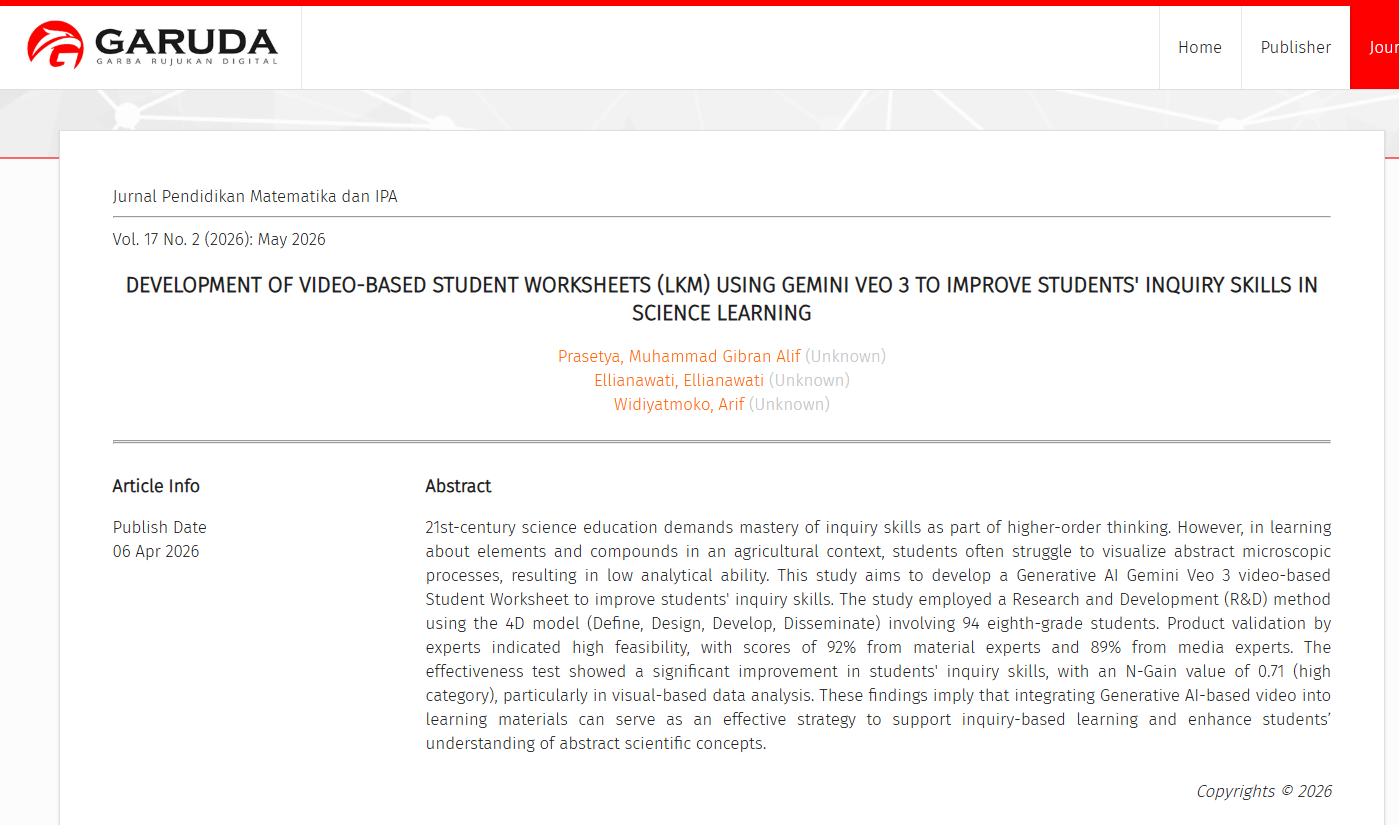
DEVELOPMENT OF VIDEO-BASED STUDENT WORKSHEETS (LKM) USING GEMINI VEO 3 TO IMPROVE STUDENTS'INQUIRY SKILLS IN SCIENCE LEARNING
21st-century science education demands mastery of inquiry skills as part of higher-order thinking. However, in learning about elements and compounds in an agricultural context, students often struggle to visualize abstract microscopic processes, resulting in low analytical ability. This study aims to develop a Generative AI Gemini Veo 3 video-based Student Worksheet to improve students' inquiry skills. The study employed a Research and Development (R&D) method using the 4D model (Define, Design, Develop, Disseminate) involving 94 eighth-grade students. Product validation by experts indicated high feasibility, with scores of 92% from material experts and 89% from media experts. The effectiveness test showed a significant improvement in students' inquiry skills, with an N-Gain value of 0.71 (high category), particularly in visual-based data analysis. These findings imply that integrating Generative AI-based video into learning materials can serve as an effective strategy to support inquiry-based learning and enhance students’ understanding of abstract scientific concepts.
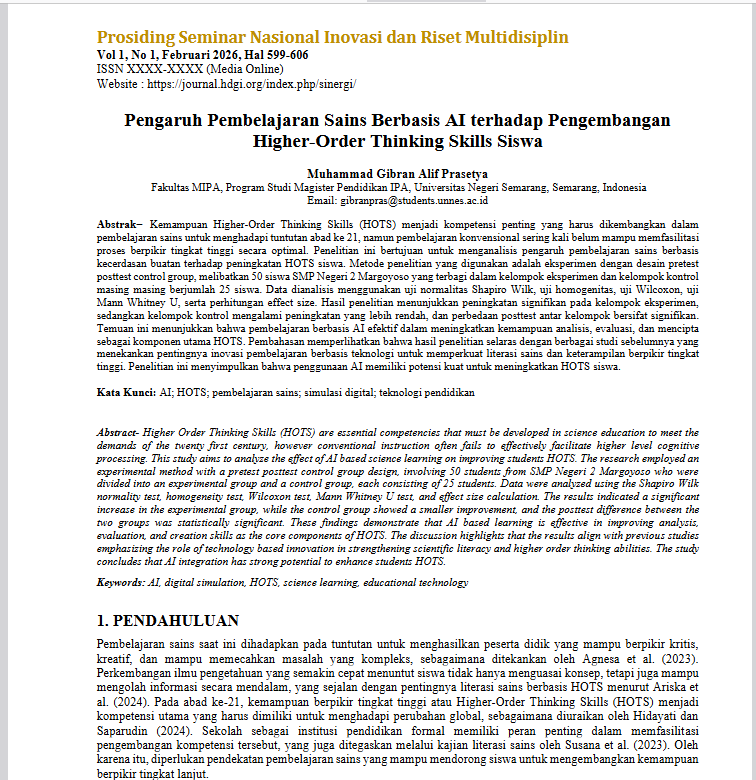
Pengaruh Pembelajaran Sains Berbasis AI terhadap PengembanganHigher‑Order Thinking Skills Siswa
Kemampuan Higher-Order Thinking Skills (HOTS) menjadi kompetensi penting yang harus dikembangkan dalampembelajaran sains untuk menghadapi tuntutan abad ke 21, namun pembelajaran konvensional sering kali belum mampu memfasilitasiproses berpikir tingkat tinggi secara optimal. Penelitian ini bertujuan untuk menganalisis pengaruh pembelajaran sains berbasiskecerdasan buatan terhadap peningkatan HOTS siswa. Metode penelitian yang digunakan adalah eksperimen dengan desain pretestposttest control group, melibatkan 50 siswa SMP Negeri 2 Margoyoso yang terbagi dalam kelompok eksperimen dan kelompok kontrolmasing masing berjumlah 25 siswa. Data dianalisis menggunakan uji normalitas Shapiro Wilk, uji homogenitas, uji Wilcoxon, ujiMann Whitney U, serta perhitungan effect size. Hasil penelitian menunjukkan peningkatan signifikan pada kelompok eksperimen,sedangkan kelompok kontrol mengalami peningkatan yang lebih rendah, dan perbedaan posttest antar kelompok bersifat signifikan.Temuan ini menunjukkan bahwa pembelajaran berbasis AI efektif dalam meningkatkan kemampuan analisis, evaluasi, dan menciptasebagai komponen utama HOTS. Pembahasan memperlihatkan bahwa hasil penelitian selaras dengan berbagai studi sebelumnya yangmenekankan pentingnya inovasi pembelajaran berbasis teknologi untuk memperkuat literasi sains dan keterampilan berpikir tingkattinggi. Penelitian ini menyimpulkan bahwa penggunaan AI memiliki potensi kuat untuk meningkatkan HOTS siswa
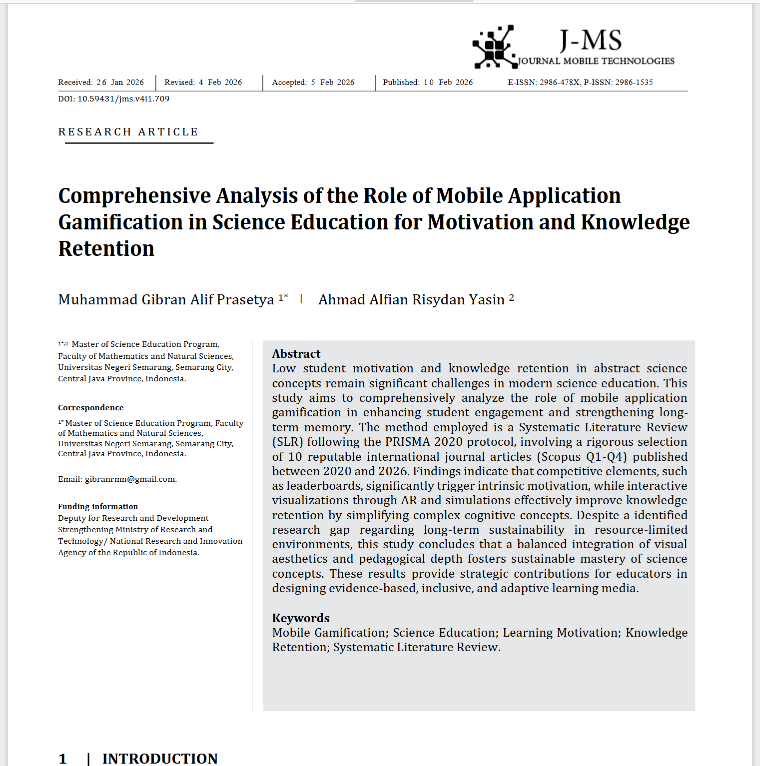
Comprehensive Analysis of the Role of Mobile Application Gamification in Science Education for Motivation and Knowledge Retention
Low student motivation and knowledge retention in abstract science concepts remain significant challenges in modern science education. This study aims to comprehensively analyze the role of mobile application gamification in enhancing student engagement and strengthening long-term memory. The method employed is a Systematic Literature Review (SLR) following the PRISMA 2020 protocol, involving a rigorous selection of 10 reputable international journal articles (Scopus Q1-Q4) published between 2020 and 2026. Findings indicate that competitive elements, such as leaderboards, significantly trigger intrinsic motivation, while interactive visualizations through AR and simulations effectively improve knowledge retention by simplifying complex cognitive concepts. Despite a identified research gap regarding long-term sustainability in resource-limited environments, this study concludes that a balanced integration of visual aesthetics and pedagogical depth fosters sustainable mastery of science concepts. These results provide strategic contributions for educators in designing evidence-based, inclusive, and adaptive learning media.
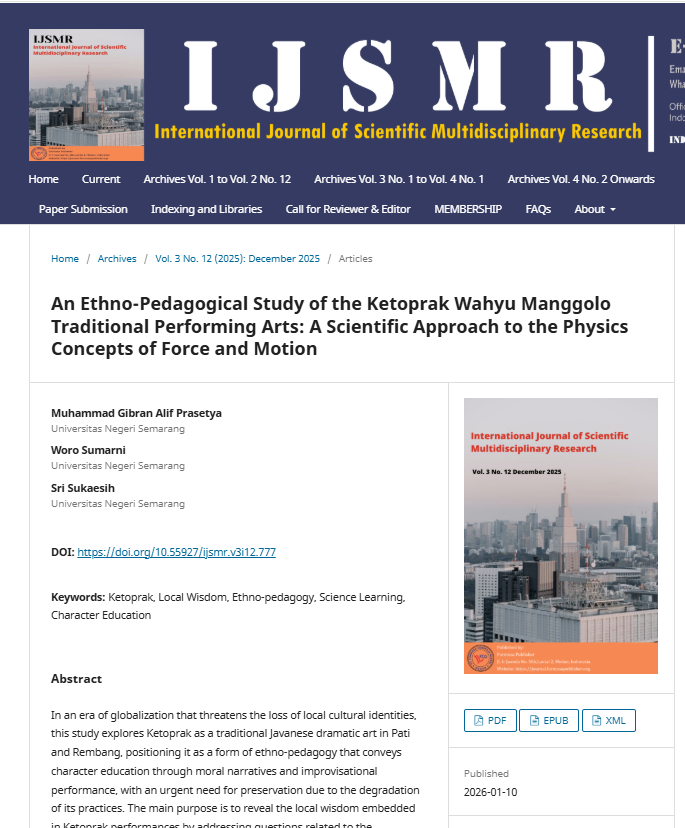
An Ethno-Pedagogical Study of the Ketoprak Wahyu Manggolo Traditional Performing Arts: A Scientific Approach to the Physics Concepts of Force and Motion
In an era of globalization that threatens the loss of local cultural identities, this study explores Ketoprak as a traditional Javanese dramatic art in Pati and Rembang, positioning it as a form of ethno-pedagogy that conveys character education through moral narratives and improvisational performance, with an urgent need for preservation due to the degradation of its practices. The main purpose is to reveal the local wisdom embedded in Ketoprak performances by addressing questions related to the representation of Javanese moral values, the challenges of safeguarding the tradition, and its potential use as learning material. Using a qualitative ethnographic design, the research employed participatory observation in two groups (Cahyo Mudo and Wahyu Manggolo) in October 2025, semi-structured interviews with ten informants, and thematic analysis. The findings show that Ketoprak serves as a medium of social cohesion through elements such as ontowencono, humorous dialogues, and messages of karma, while facing the challenge of declining interest among younger generations, which is addressed through adaptive strategies such as modern staging and community-based revitalization. These efforts contribute to the integration of traditional arts into formal education in the form of the results of the reconstruction of scientific knowledge of ketoprak for science learning (physics concepts: force and motion).